

What to Wear With a Navy Blazer (Trousers, Shirt, Shoes and Tie)
For men, the easiest things to wear with a navy blazer are mid-grey trousers, beige or sand chinos, or dark indigo jeans, with a white or light blue shirt and brown or black leather shoes. Which ones you choose sets the formality: grey wool trousers, a tie and black Oxfords are business formal, chinos and an Oxford button-down are business casual, and jeans, a chambray shirt and boots are smart casual.
A navy blazer works with almost every color you already own, which is why it is the piece to build outfits around. This guide answers what people search for most: which color trousers to wear with a navy blazer, which shirt, shoes and tie to add, whether you can wear it with jeans, black pants or sneakers, and how to build an outfit for each dress code.
Quick answers
| Question | Short answer |
|---|---|
| What color trousers go with a navy blazer? | Mid-grey, charcoal, beige, sand, mushroom, off-white, light grey, light brown and dark indigo jeans |
| What shirt goes with a navy blazer? | White or light blue for almost everything. Chambray or a striped shirt for casual looks |
| What shoes go with a navy blazer? | Black or very dark brown Oxfords for business formal. Brown loafers, Oxfords, derbies or boots for everything else |
| What tie goes with a navy blazer? | A textured or patterned tie that echoes one color in the outfit: regimental stripe, houndstooth, grey knit or wool, or a foulard |
| Can you wear a navy blazer with jeans? | Yes. Dark indigo, straight, no fading or distressing, and a blazer with some texture |
| Can you wear a navy blazer with black pants? | You can, but it is not the best pairing. Grey, beige or brown look better |
| Does a navy blazer need a tie? | No. A tie moves it toward business wear, an open collar toward smart casual |
What color trousers go with a navy blazer?
Navy is a dark, neutral color, so almost any trouser color that contrasts with it works. The contrast is the point: light and mid-tone trousers make a navy blazer look deliberate. A navy blazer with navy trousers looks like a mismatched suit, so avoid the same shade. Here are the five trousers I would build a blazer wardrobe around, from most formal to most casual.
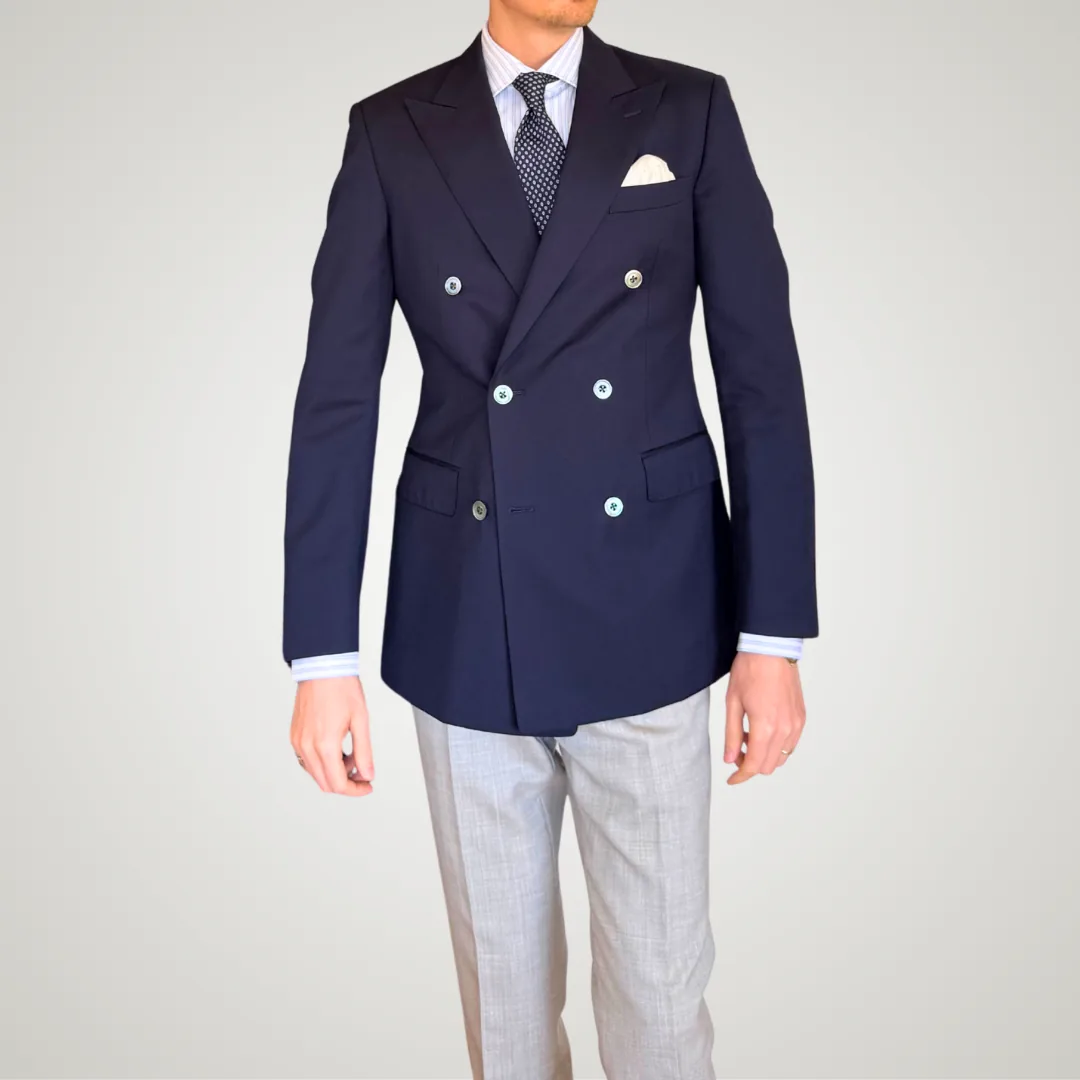
Mid-grey gabardine trousers (business formal)
Gabardine has a tight weave with a smooth, sleek surface and a slight sheen, which makes it the dressiest trouser to wear with a blazer. Mid-grey is the most versatile trouser color: a neutral that lets other colors stand out. It works with a navy blazer, an off-white jacket, brown, blue or green jackets, and with any jacket color except a grey one in the same shade. Wear them with black Oxfords for maximum formality, or very dark brown Oxfords for a slightly softer business look.
Mid or dark grey flannel trousers (business to smart casual)
Flannel has a soft, brushed texture you can see and feel. That texture is what makes the trousers flexible: they are dressy enough for business and casual enough for a textured jacket and an Oxford button-down. Wear them with the same shoes as gabardine: black or very dark brown Oxfords, or black loafers. Flannel lowers the formality of the whole outfit through texture alone.
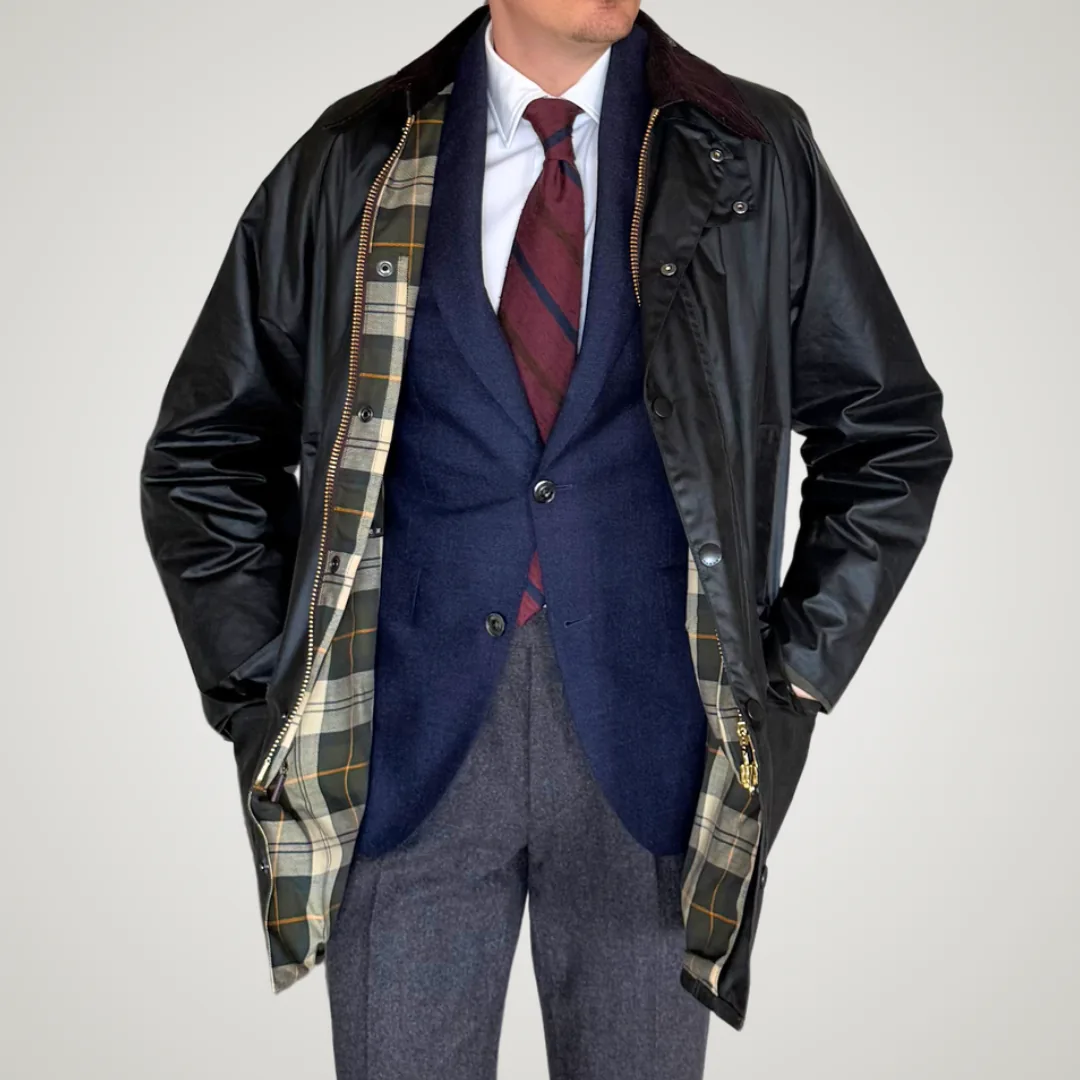
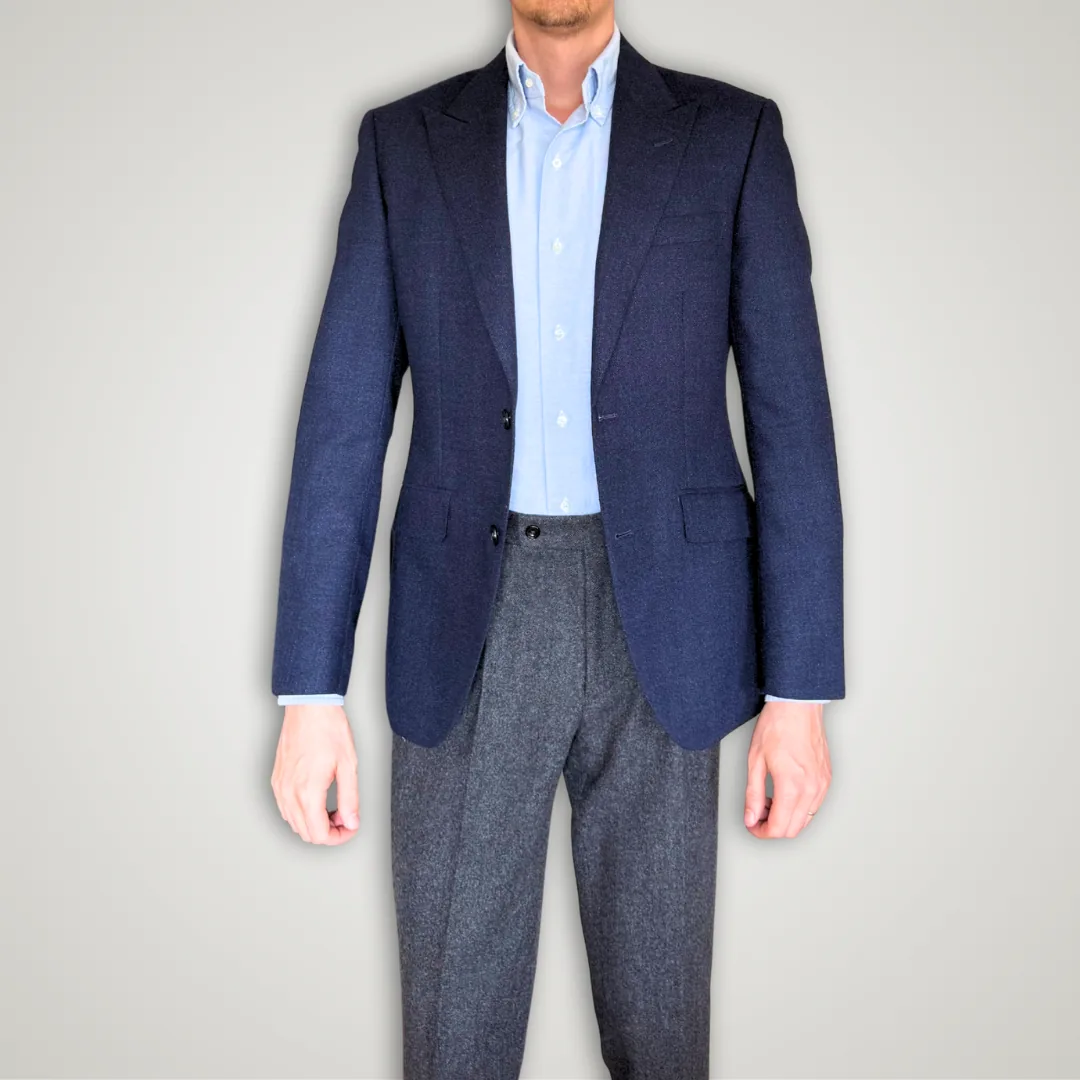
Both outfits use charcoal flannel trousers from Tollegno 1900 with the same fresco blazer. On the left it is dressed up with a white pinpoint Oxford shirt and a dark red shantung tie with blue and brown stripes, with a Barbour Beaufort waxed cotton jacket over it for cold weather. On the right it is dressed down with a light blue Oxford cloth button-down, no tie, and the jacket worn open.
Linen or wool-linen trousers in off-white, light grey or light brown (summer)
Pure linen breathes best, and a wool-linen blend wrinkles less and lasts longer. The light colors matter because they contrast with navy, which is what makes summer outfits work: off-white linen trousers, a navy blazer and a light blue shirt look bright and seasonal. They go with almost any jacket you own and with both dress shirts and casual linen or cotton shirts. Choose lighter shoes: light or medium brown loafers or Oxfords.
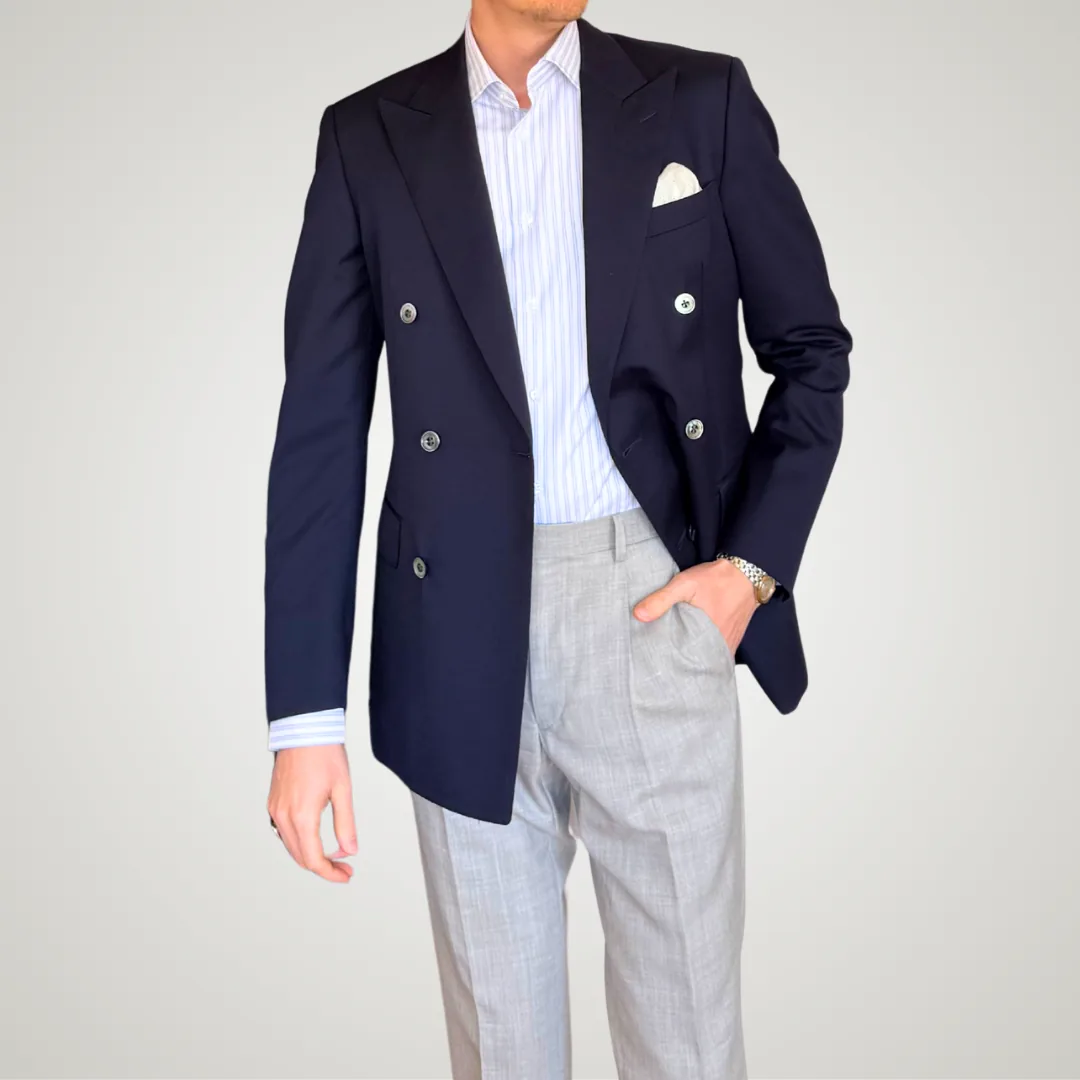
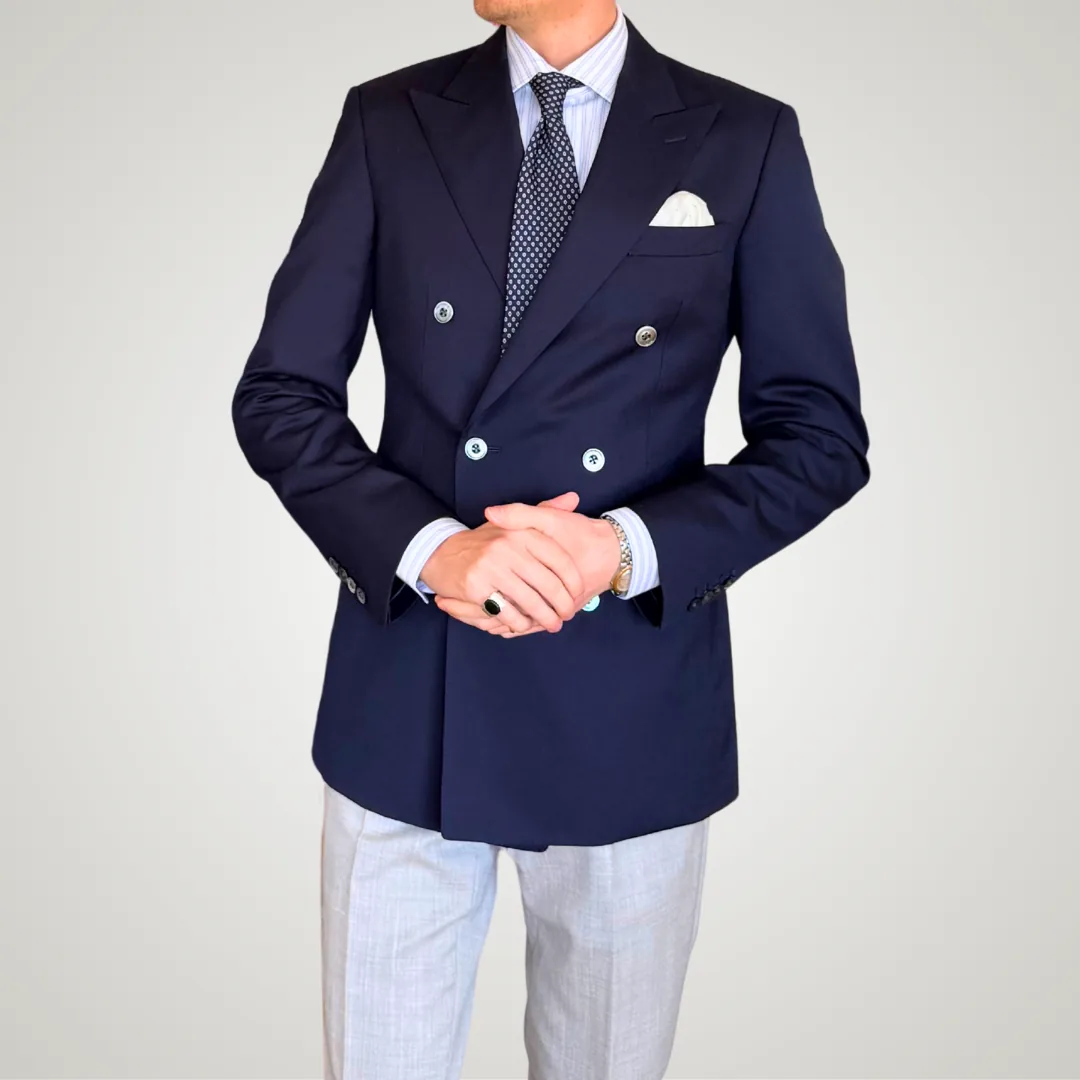
The same light grey wool-linen trousers and striped dobby shirt, once with the jacket open and no tie, and once with a foulard silk tie with a small flower pattern.
Sand or mushroom cotton chinos (smart casual to business casual)
If you could only own one casual trouser, this would be it. Sand and mushroom coordinate with nearly every jacket color and still look intentional. Navy blazer, chinos and an Oxford cloth button-down is a reliable business casual combination, and chinos alone with a shirt still look put together. Any casual leather shoe works: loafers, casual Oxfords, derbies and boots.
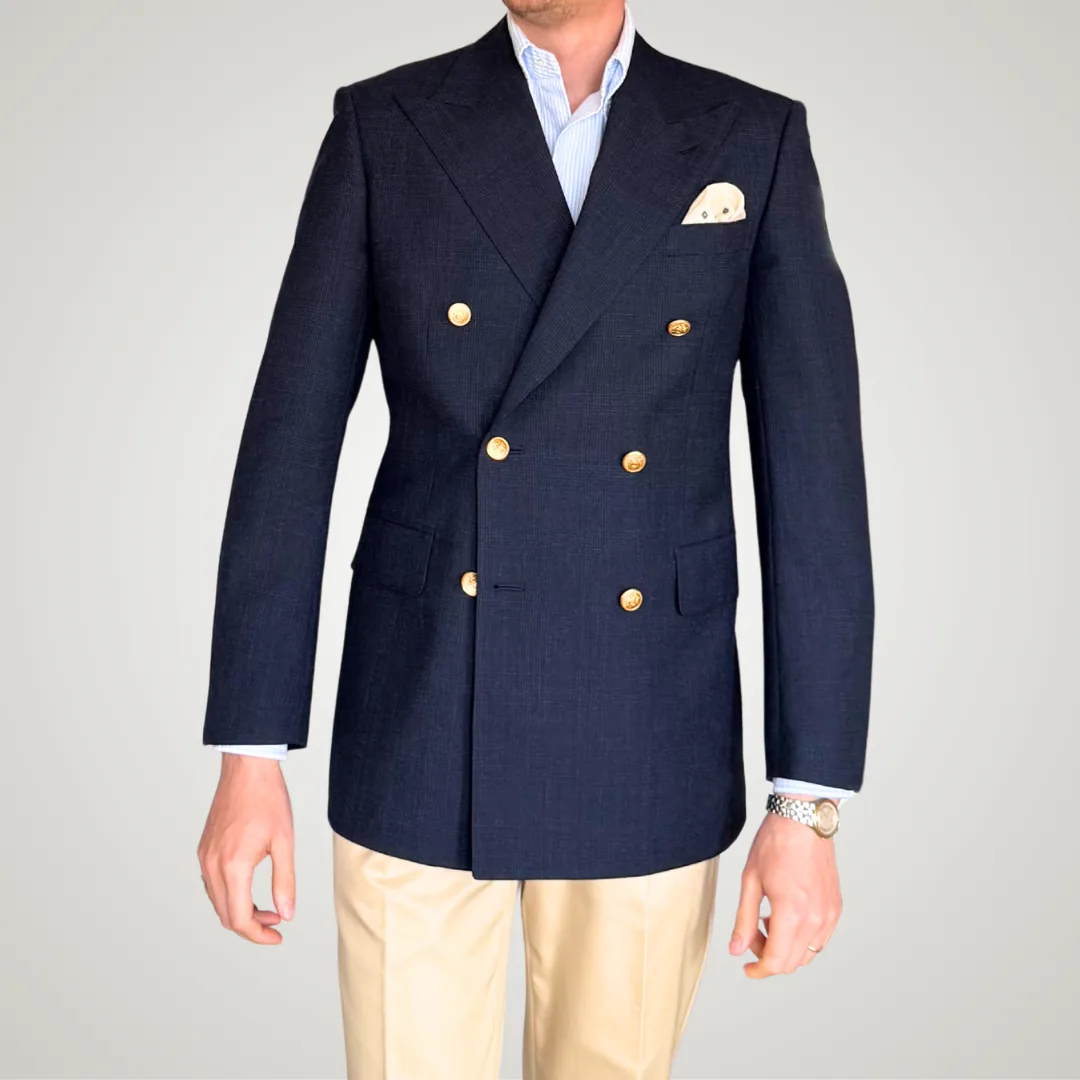
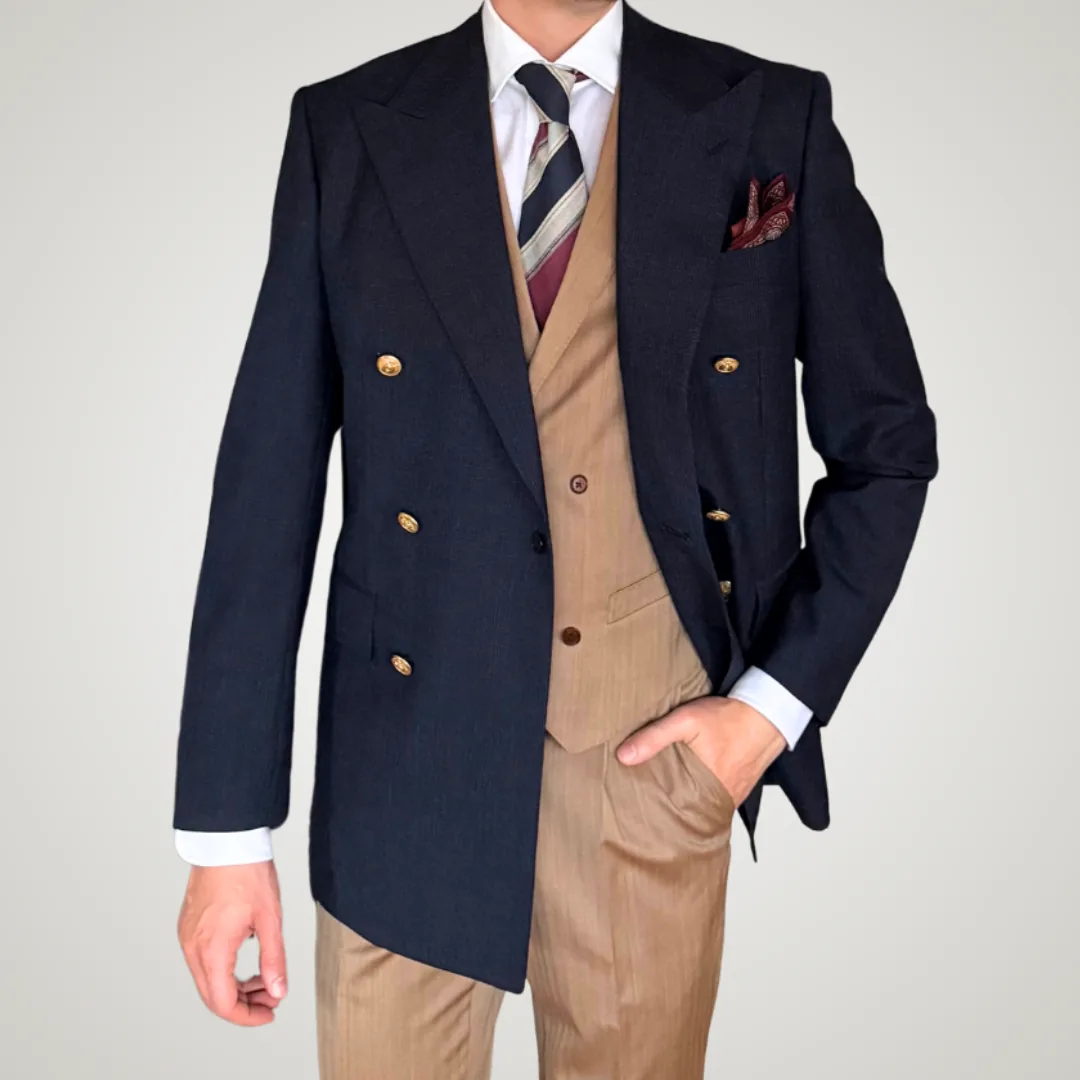
On the left, sand cotton trousers with a light blue striped Oxford cloth button-down and no tie. On the right, the same gold-buttoned blazer over a tan Solaro waistcoat and trousers from Tallia di Delfino, with a white linen-cotton shirt and a navy, cream and red regimental tie from the Italian collection of Kamakura shirts.
Dark indigo jeans (smart casual)
Choose dark indigo in a straight fit with clean lines: no distressing, no fading, not skinny. Dark indigo jeans go with all your casual shirts, with a roll-neck sweater, and with a navy blazer that has some texture. See the section on jeans below. White jeans are a bolder summer option that contrasts strongly with navy.
What shirt goes with a navy blazer?
White and light blue are the foundation, because they work with every tie and every pair of trousers above.
- White pinpoint Oxford: the business foundation. It creates the most contrast, works with every tie and signals that you understand a professional dress code.
- Light blue pinpoint Oxford or dress shirt: adds a little color while staying versatile. It is the natural partner for grey trousers and a grey tie.
- Light blue Oxford cloth button-down (OCBD): the best choice for an outfit without a tie, because the button-down collar holds its shape on its own. Pair it with sand or mushroom chinos.
- Knit polo: a relaxed option with a textured blazer, in a blue that is a little brighter than the jacket, with wool-linen trousers.
- Chambray: brings a casual, denim-like look while keeping the structure of a dress shirt. Pair it with dark indigo jeans.
- Blue-striped Oxford button-down or Bengal stripe shirt: a striped shirt adds personality in casual looks. A Bengal stripe in a linen-cotton blend is ideal with white jeans in summer.
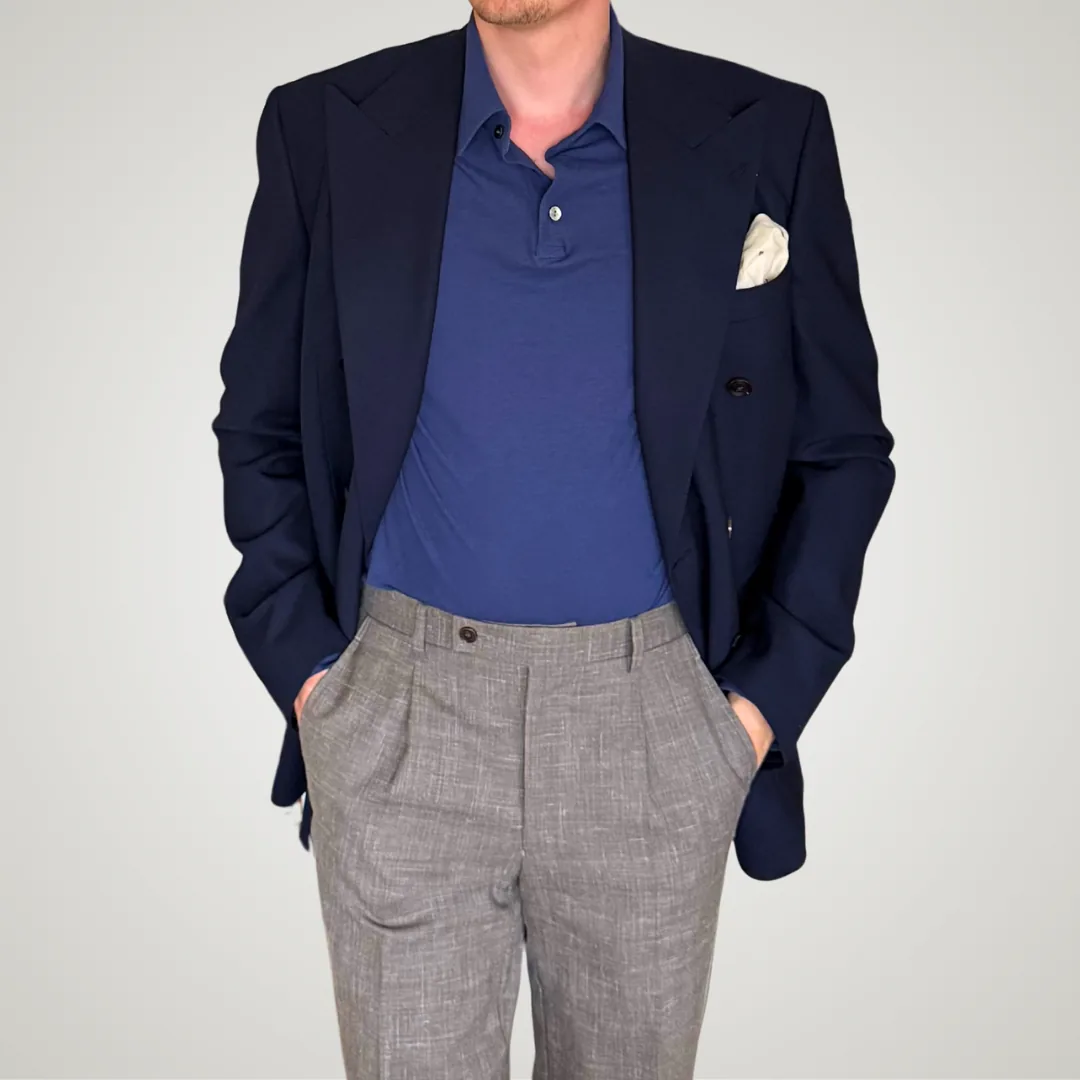
The simple rule: the more casual the outfit, the more texture and weave you can see in the shirt. The more formal, the smoother and whiter it should be.
What shoes go with a navy blazer?
Match the shoes to the trousers and the occasion. Darker, smoother and more closed shoes are more formal, and lighter, suede and rougher shoes are more casual.
| Shoes | Wear them with | Formality |
|---|---|---|
| Black Oxfords | Mid-grey gabardine trousers, white shirt, tie | Business formal |
| Very dark brown Oxfords | Grey gabardine or flannel trousers | Business |
| Black penny loafers | Charcoal gabardine or grey flannel trousers, Oxford button-down, pocket square in a puff fold; or dark indigo jeans | Smart casual to business casual |
| Dark brown tassel loafers | Medium-grey gabardine, light blue shirt, knit tie | Business casual |
| Brown tassel loafers | Mushroom chinos, chambray shirt, no tie | Casual to business casual |
| Medium to dark brown Oxfords | Light grey linen trousers, regimental tie | Business casual, warm weather |
| Light or medium brown loafers or Oxfords | Off-white, light grey or light brown linen trousers | Summer |
| Light brown suede penny loafers | White jeans, Bengal stripe shirt | Casual summer |
| Dark brown Chelsea boots | Mushroom chinos, light blue OCBD | Smart casual |
| Brown jodhpur boots | Dark indigo jeans, chambray shirt | Smart casual, cooler months |
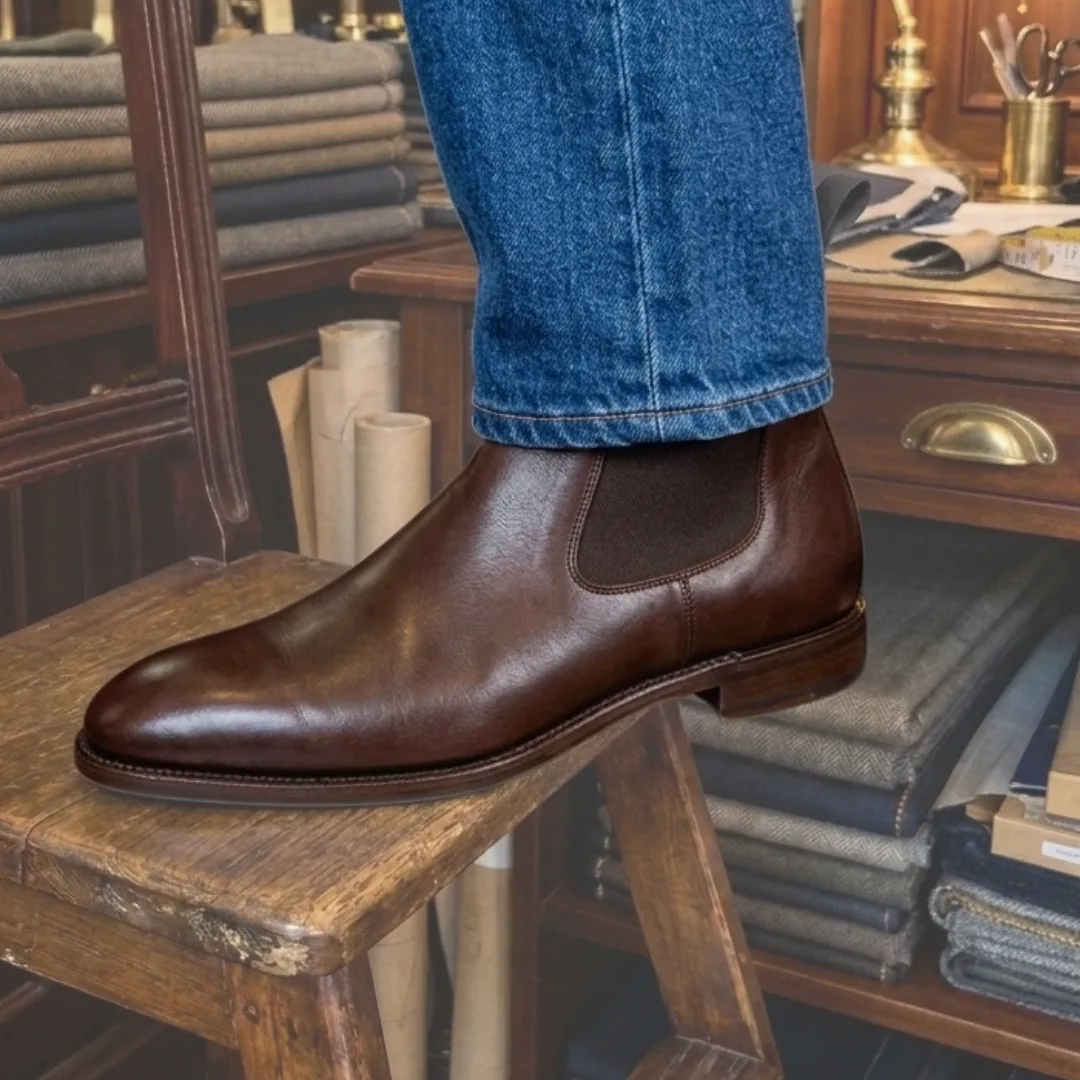
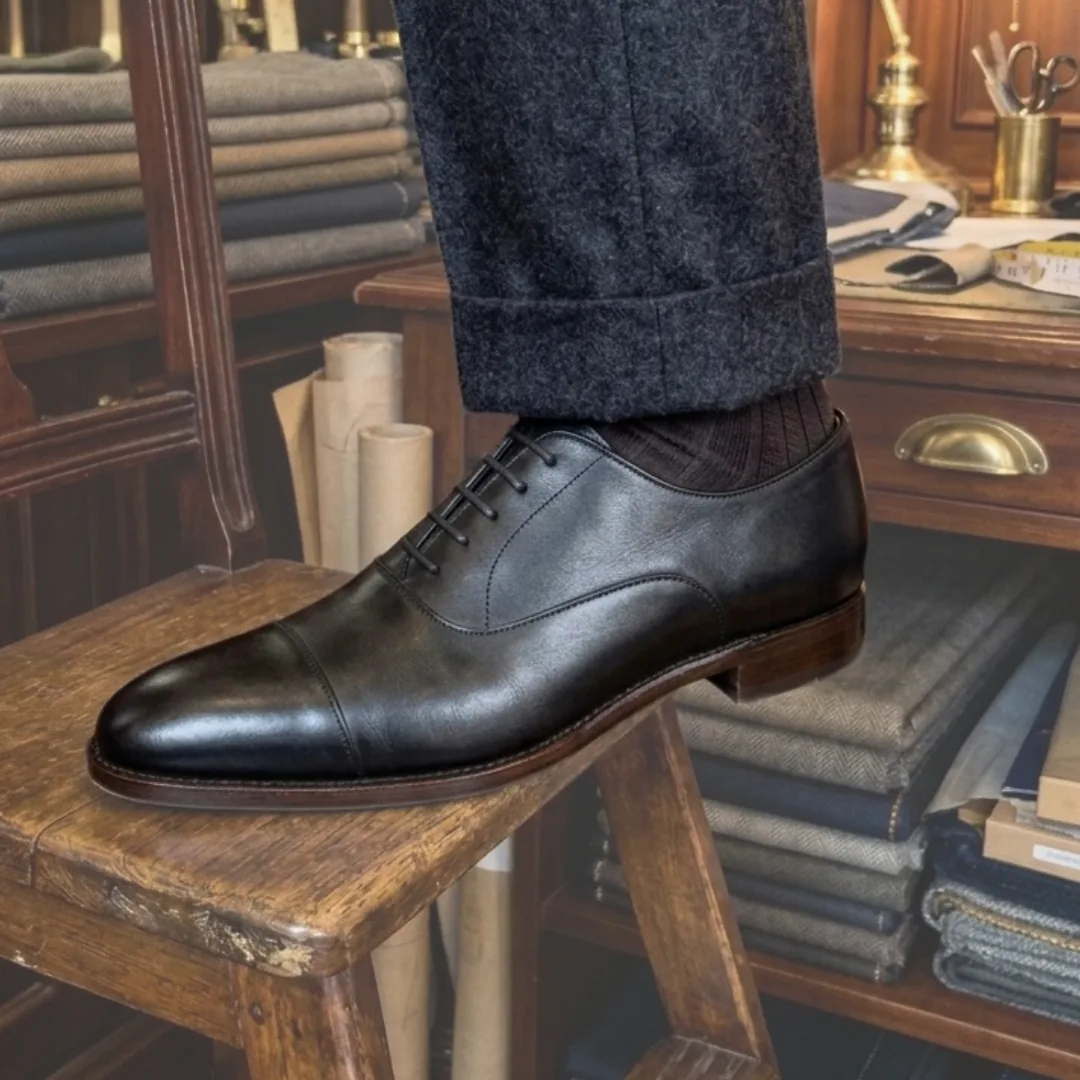
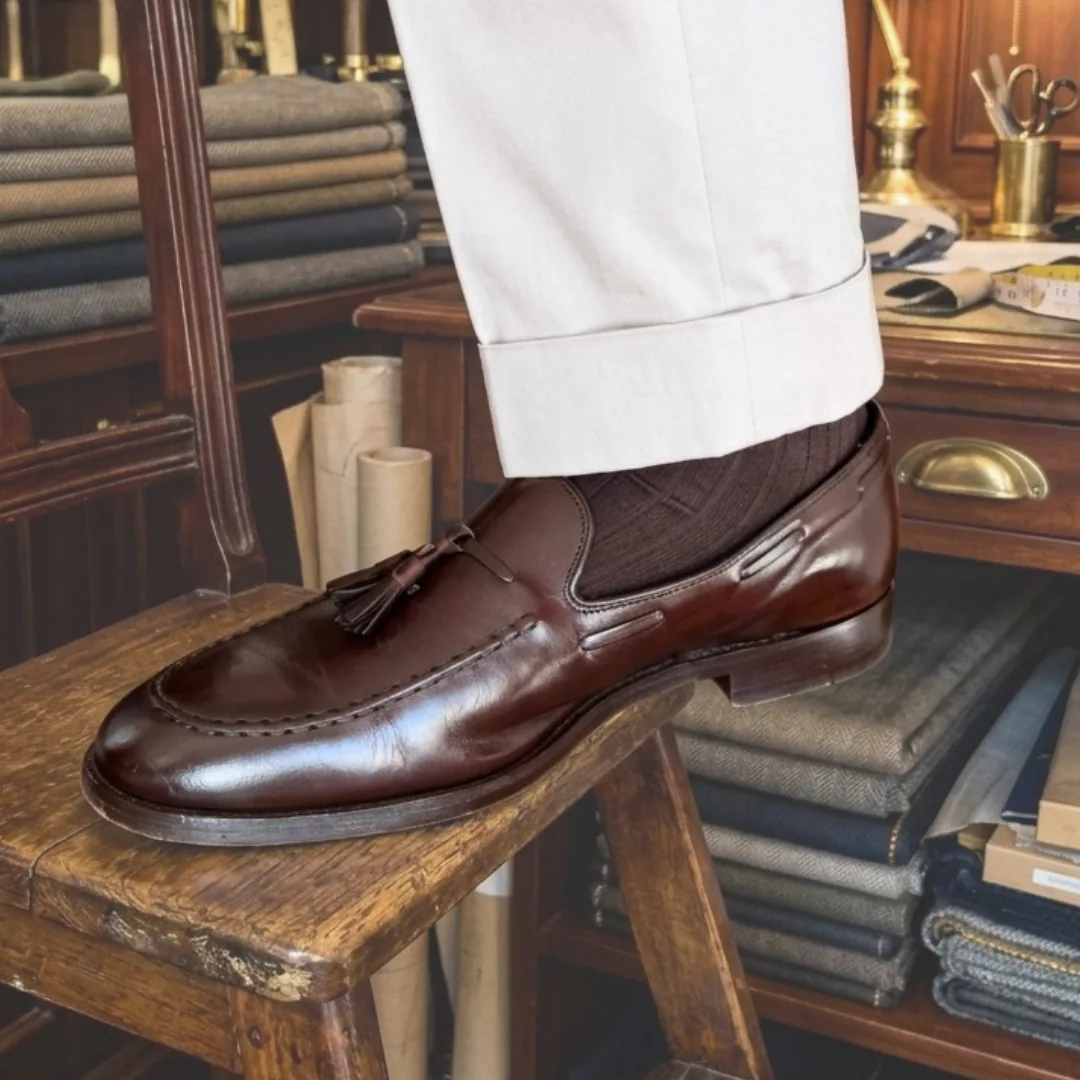
From left to right: dark brown Chelsea boots with mid blue jeans, black cap-toe Oxfords with charcoal flannel trousers, and dark brown tassel loafers with mushroom cotton trousers.
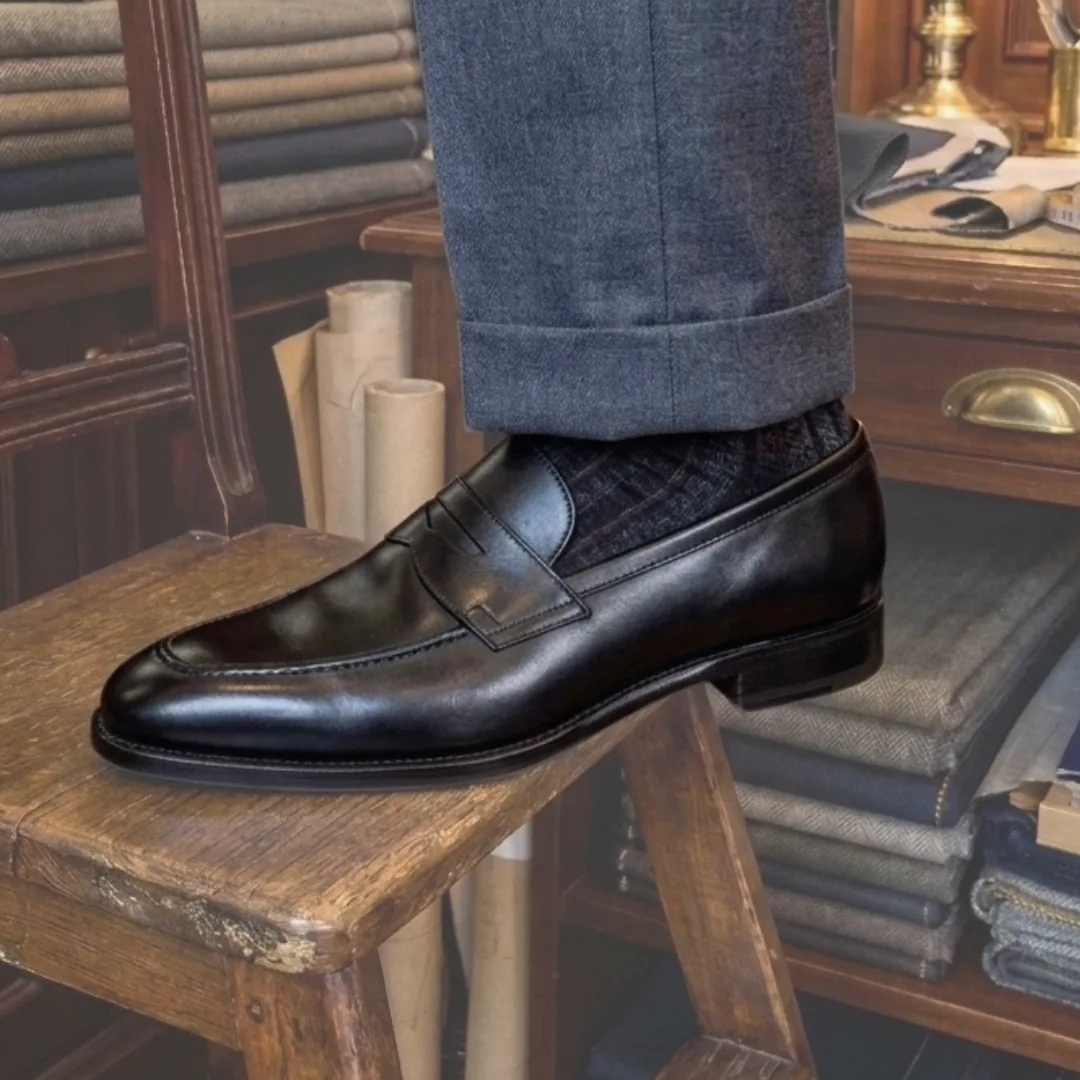
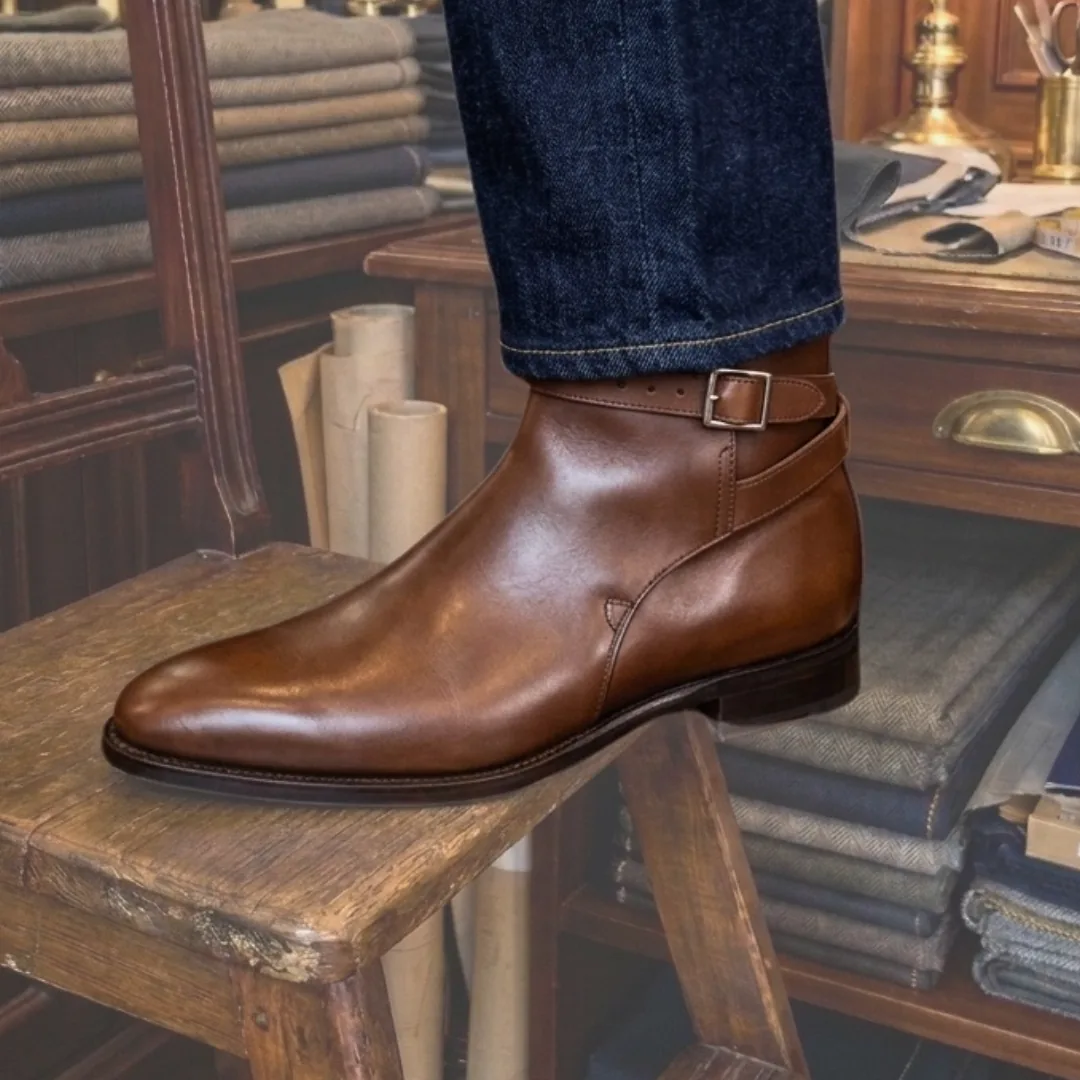
Black penny loafers with grey gabardine wool trousers, and brown jodhpur boots with dark indigo jeans.
Loafers have their own ladder. Brown tassel loafers are the most casual of the three: they work perfectly for business casual and go well with textured cloth like flannel and chambray. They are not the best option for the most conservative business dress codes, where you have to be strict. They also work with navy suits, and many sartorial dressers wear them with a formal blazer outfit. Black penny loafers sit in the middle, more formal than tassels and less formal than lace-ups, and they handle most smart casual and business casual outfits. Light brown suede penny loafers are for summer. Lace-up Oxfords are the most formal.
One more rule from my suit-mistakes video: light tan or light brown shoes look off under dark wool in charcoal or navy, because they pull attention down and away from the face. Dark brown with navy or grey is fine. Keep light brown for light trousers, such as off-white, light grey or sand.
Black or brown? Both work with navy. Black is the most formal and goes with grey. Brown is softer and works with everything from grey to beige, and it is the better choice with light trousers.
What tie goes with a navy blazer?
Before the specific ties, these are the three things I check when I match a tie to a navy blazer.
- Texture. A smooth, shiny solid navy or grey silk tie with a smooth shirt makes the whole outfit look default and flat. Choose a tie with texture, or one where the pattern does the job: a houndstooth or glen check jacquard, a grenadine, a knit, a wool tie or a foulard.
- Color echo. Pick a tie that repeats one color already in the outfit. A regimental tie with navy and red, for example, pulls the blazer, shirt and trousers together. The color does not have to match exactly; one close color is enough.
- Contrast. The tie should be clearly different from the shirt so it does not disappear. Usually that means a darker tie against a crisp white or light blue shirt. A lighter tie can work if it has a pronounced pattern or texture. If you wear a navy tie with a navy blazer, make it a little darker or brighter than the blazer's navy.
These are the ties I would start with:
- Regimental stripe: the most flexible tie for a navy blazer, as long as it contains navy or blue. A navy tie with gold or bronze and green accents works with a white pinpoint Oxford shirt and mid-grey trousers for business formal, or with a textured navy blazer for business casual. Navy and red lets you wear the same tie with brown trousers and jackets too. A navy and cream or white stripe has a maritime look and suits summer, for example with light grey linen trousers. Many regimental stripes belong to specific clubs, schools or regiments, so choose patterns that are less likely to carry a strong association if you care about etiquette.
- Houndstooth or glen check jacquard in charcoal and silver: conservative with a Scottish and British heritage, and woven into the cloth, so it adds a subtle visual cue to a smooth navy blazer. It works with a white or light blue shirt, and even with a lilac one.
- Grey silk tie with a diamond or geometric pattern: grey and navy work very well together. Wear it with a white shirt for a formal look, because a blue shirt gives less contrast. A solid grey tie in the same grey as your trousers looks too matchy.
- Foulard in navy and burgundy: a small repeating geometric pattern, smooth but visually interesting. It looks best against a crisp white shirt.
- Grey knit or wool tie: texture does the work here. A knit tie with a light blue shirt and grey gabardine trousers, or a wool tie with flannel trousers, adds a casual note to a business outfit.
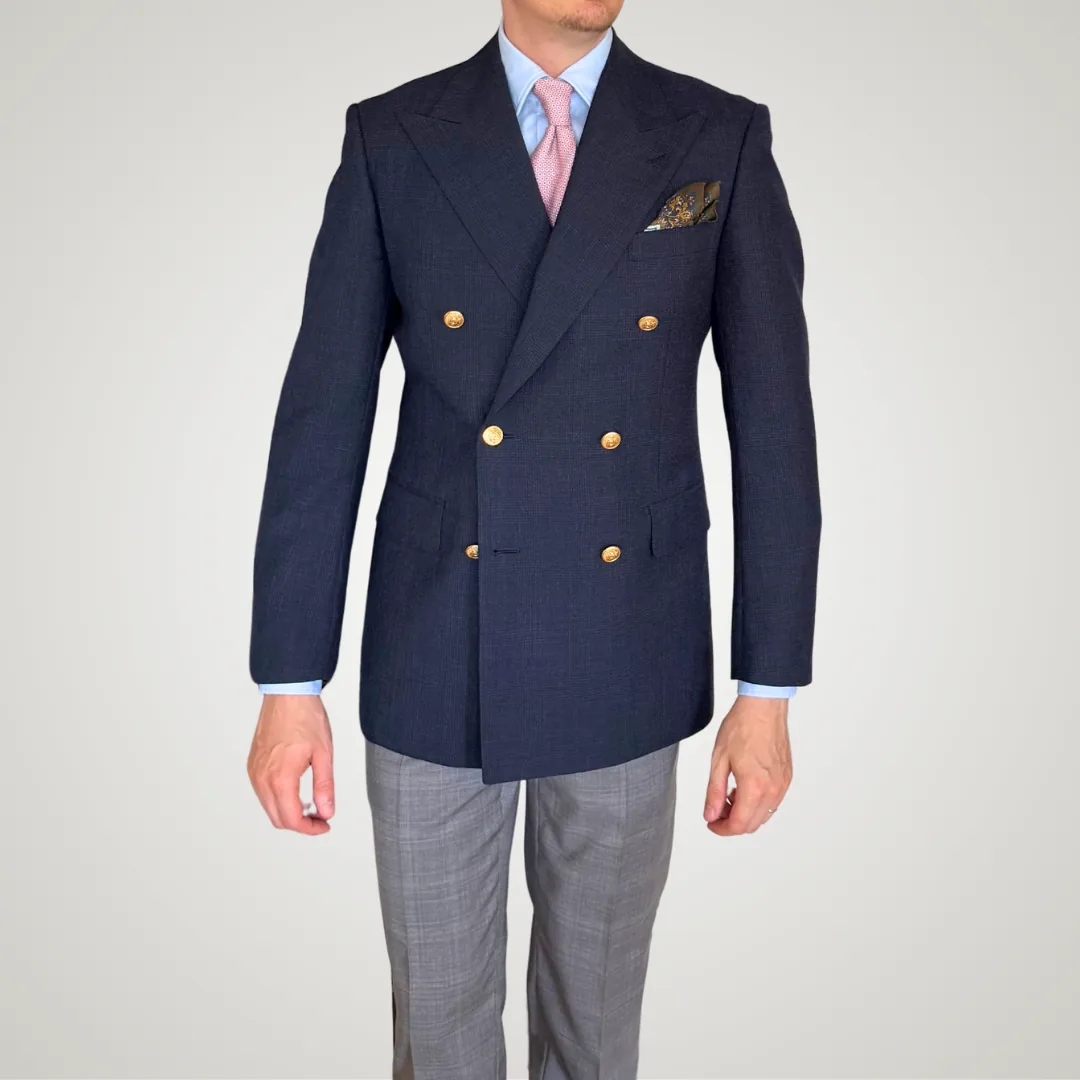
- Pinkish peach silk tie with a small pattern: a muted color with a light blue pinpoint Oxford shirt and mid-grey glen check trousers, which suits a gold-buttoned blazer.
- Solid light blue silk tie: a warm-weather option with a light blue shirt and light grey wool-linen trousers.
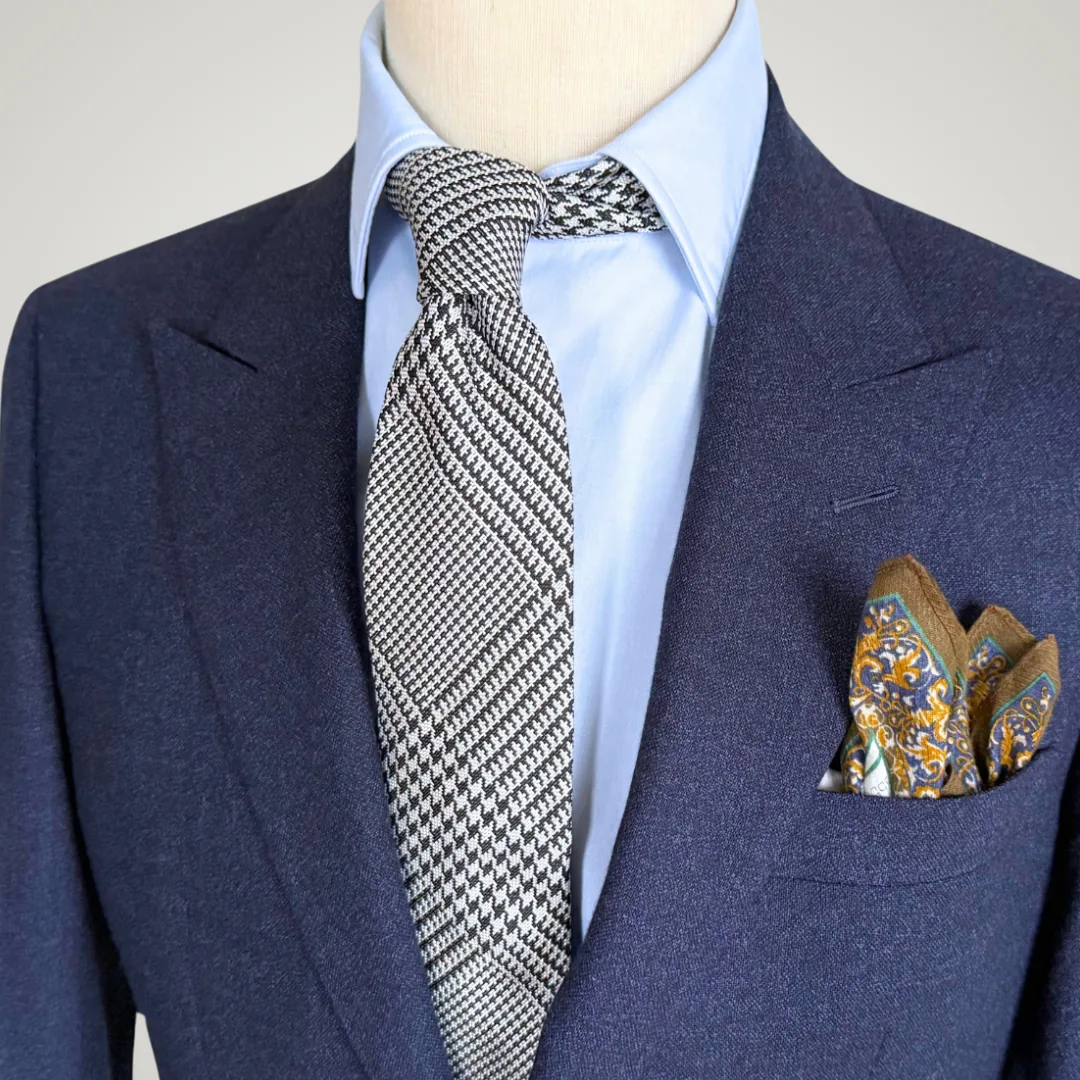
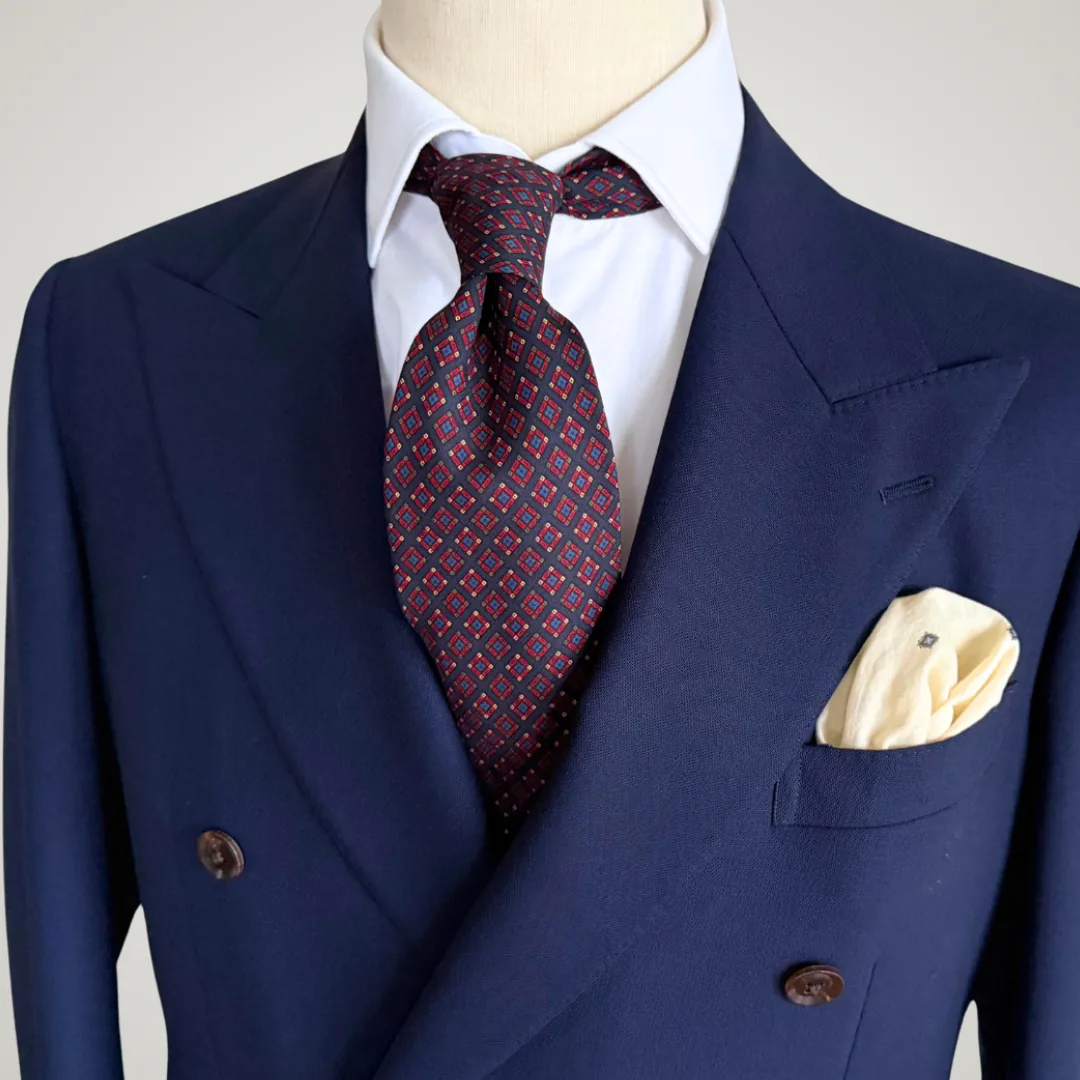
On the left, the houndstooth and glen check jacquard tie, where the pattern is the weave itself and not printed. On the right, the navy foulard with a burgundy pattern against a white shirt.
If you do want a solid navy tie, choose a textured one such as a grenadine or a knit instead of a smooth silk. Silk is dressier, wool and knit are more casual. A tie in a stripe that runs from top right to bottom left, toward the heart, usually follows the British convention, and one from top left to bottom right the American.
Knot size should match the tie: a four-in-hand gives a smaller, slimmer knot and suits a tie with thick interlining, and a Windsor fills the space between the collar points better on a tie with thin interlining. Without a tie, choose an Oxford button-down or chambray shirt and a textured blazer, and leave the top button open.
Can you wear a navy blazer with jeans?
Yes, and it is one of the most searched outfits. It looks easy, but most men get it wrong, and it is almost never the jeans. It is the cloth of the jacket. These are the guidelines I follow.
- Check the jacket's cloth first. Jeans are casual, so the jacket has to sit fairly close to them. Texture moves a jacket up or down the formality scale more than anything else. A smooth, flat worsted, the cloth of most suit jackets, looks formal, and next to denim it looks like the top half of a suit that lost its trousers. A textured cloth such as flannel, herringbone, hopsack, gabardine, Saxony, slubby wool and linen or tweed sits closer to jeans. The test: hold the jacket at arm's length. If you can see the weave from there, it works with jeans. If it looks flat, even and almost shiny, it does not.
- A smooth navy jacket can work if you change the buttons. If your only jacket is a smooth navy one, give it contrasting buttons (gilt or mother-of-pearl) so it reads as a navy blazer and not as a navy suit jacket. It is a good trick when the trousers of your navy suit have worn out. See what makes a navy blazer.
- Match the jeans to the jacket. If the jacket is textured, the wash can be dark, medium blue, light, cream or white. Dark indigo is the easiest and the most refined, but texture is what makes the others work. A double-breasted jacket works with jeans too, as long as the cloth is textured.
- Let the shirt follow the texture. An Oxford cloth button-down is the safest choice, a polo works, and so does a subtly textured open-collar shirt. A crisp, smooth dress shirt with a high yarn count (120s or 140s, a fine, smooth, shiny cloth) is too sleek and pulls the outfit apart.
Other details:
- Tie: wear one only if it is textured: wool, knit or a rough silk such as shantung. A smooth, shiny tie brings back the problem of the smooth jacket.
- Belt: leather in the color of your shoes, 2.5 to 3 cm wide. Anything wider looks too bulky and casual, and a loud buckle makes it worse. Let the jeans and the jacket speak louder than the belt.
- Fit: comfortable slim (not skinny) to a regular straight fit with a clean leg. Baggy jeans under a tailored jacket throw the jacket out of proportion.
- Shoes: brown boots such as jodhpur or Chelsea boots, or loafers. Black penny loafers elevate dark indigo jeans, especially with a black roll-neck sweater.
Three navy blazer outfits with jeans that I like:
- Weekend: a textured single-breasted blazer, a chambray shirt, dark indigo jeans and brown jodhpur boots.
- Monochrome: a navy textured blazer, a black roll-neck sweater, dark indigo jeans and black penny loafers, without a pocket square. The black creates continuity from torso to feet and lets the blazer stand out as the color.
- Summer: a textured double-breasted blazer, a Bengal stripe shirt, white jeans and light brown suede penny loafers.
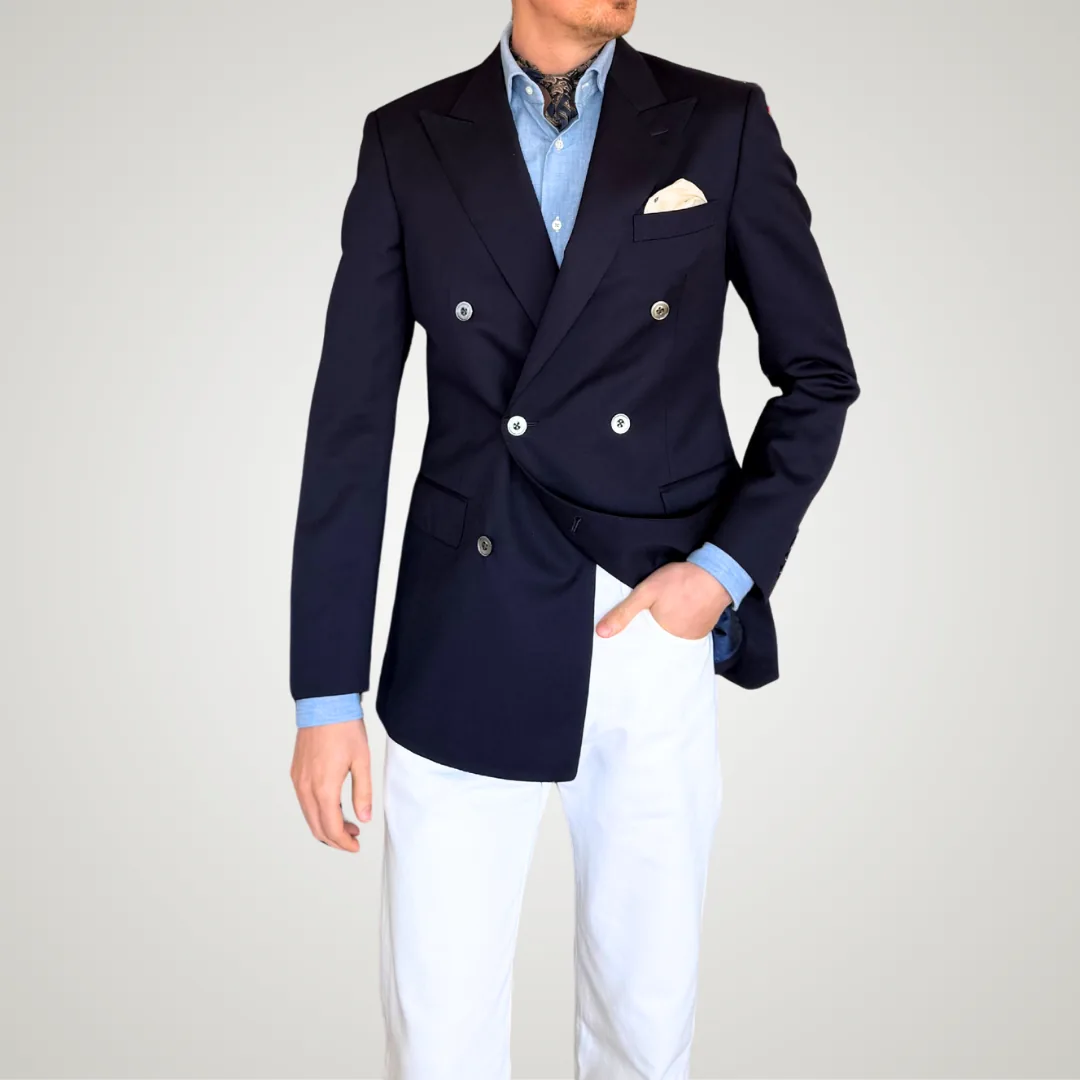
Another white jeans outfit: a navy twill double-breasted blazer with white mother-of-pearl buttons, a chambray shirt, a navy neckerchief and a cream pocket square.
Outfit formulas for each dress code
A short version of how the pieces fit together. I explain each outfit in detail in the dress-code guides.
| Dress code | Blazer | Shirt | Trousers | Shoes | Tie |
|---|---|---|---|---|---|
| Smart casual (weekend) | Textured single breasted | Chambray | Dark indigo jeans | Brown jodhpur boots | None |
| Smart casual (elevated) | Textured single breasted | Light blue OCBD | Mushroom chinos | Dark brown Chelsea boots | None |
| Smart casual (summer) | Double breasted | Bengal stripe, linen-cotton | White jeans | Light brown suede penny loafers | None |
| Smart casual (tailored) | Single breasted | Oxford button-down | Charcoal gabardine | Black penny loafers | None, pocket square in a puff fold |
| Smart casual (relaxed) | Double breasted | Chambray | Mushroom chinos | Brown tassel loafers | None |
| Smart casual (monochrome) | Textured | Black roll-neck sweater | Dark indigo jeans | Black penny loafers | None |
| Business casual | Single breasted | Light blue pinpoint Oxford | Mid-grey gabardine | Dark brown tassel loafers | Grey knit |
| Business casual (summer) | Double breasted | White pinpoint Oxford | Light grey linen | Medium to dark brown Oxfords | Cream and navy regimental |
| Business formal | Single breasted | White pinpoint Oxford | Mid-grey gabardine | Black Oxfords | Navy, gold and green regimental |
| Business formal (summer) | Double breasted | Light blue dress shirt | Light grey wool-linen | Medium to dark brown Oxfords | Solid light blue silk |
Even a double-breasted blazer, which is the more formal cut, can be worn casually. It is a question of the rest of the outfit.
Details that make the outfit look right
These are my opinions, with my reasons. I am firm on the first one only.
- Jacket length: the jacket should cover the seat. A jacket that stops above it looks a size too small and throws off the proportions of torso and legs.
- Trouser length: the hem should cover at least the tip of the tongue where the laces start, so the shoe looks smaller and more elegant. Trousers that are short and very tapered show too much shoe.
- Socks: over-the-calf socks, so no stripe of bare leg shows when you sit and cross your legs. I wear them with wool trousers and even with jeans and leather shoes.
- Belt: leather in the color of your shoes. For more casual outfits, such as with jeans, 2.5 to 3 cm is right. If you prefer a subtler belt for smart outfits with a navy blazer and wool trousers, choose 2 cm, perhaps with a small gold buckle, so the line from torso to legs is not interrupted too much. Otherwise, wear side adjusters or suspenders instead of a belt (suspenders add another layer of heat in a Tokyo summer).
- Texture: smooth on smooth is the default. If you skip the tie, a more textured jacket and a more matte shirt look better than a sleek jacket with a silky shirt.
Pocket squares
The fold sets the tone. A presidential fold is clean, crisp and formal, so use it in business formal outfits, with a white pocket square. A puff fold is more relaxed and suits business casual and smart casual. A three-point crown fold is slightly more relaxed than the presidential and works with a light, subtly patterned square in summer.
Common questions
Keep going
- What makes a jacket a navy blazer, and the difference from a navy suit jacket: What Is a Navy Blazer?
- Get your wardrobe rated for free to discover which outfits you can create and what's still missing: engine.thethoughtfulstyle.com
- Get my free 19-Piece Framework to build a coherent wardrobe with all the essentials you need: thoughtfulstyle.kit.com/19-piece-framework